A 17th-century Oxfordshire farmhouse, gracefully restored by Max Rollitt

The owner of this handsome 17th-century Oxfordshire farmhouse, with its wonky façade of faded red brick and gleaming knapped flint, first visited it at the age of 14. ‘We lived in a modern house at the other end of the village and I came to a Young Farmers’ meeting here,’ she says. ‘I remember sitting in the kitchen in front of a roaring fire.’ Was this the moment she fell in love with the house and vowed that one day she would buy it? ‘No,’ she says with a laugh. ‘I was far more interested in the young farmers.’
The second time she walked through its panelled front door was six years ago, by which time she had a career in journalism and was married with two teenage daughters. ‘We had been living in South Africa, came back to London and then decided we wanted to move to the country. My husband was also brought up in the area, so it was an obvious place to look. We saw so many houses – then this came up. It was completely unspoilt and had the most beautiful, lived-in feel. We moved in and made no changes at all for a year, as we were terrified of losing the period atmosphere.’ With the house came the adjacent farm buildings – including stables and three large barns with gabled clay-tile roofs and dark timber cladding – plus seven acres of land. ‘What we did do, though, in the first week we were here,’ she says, ‘was buy some chickens.’

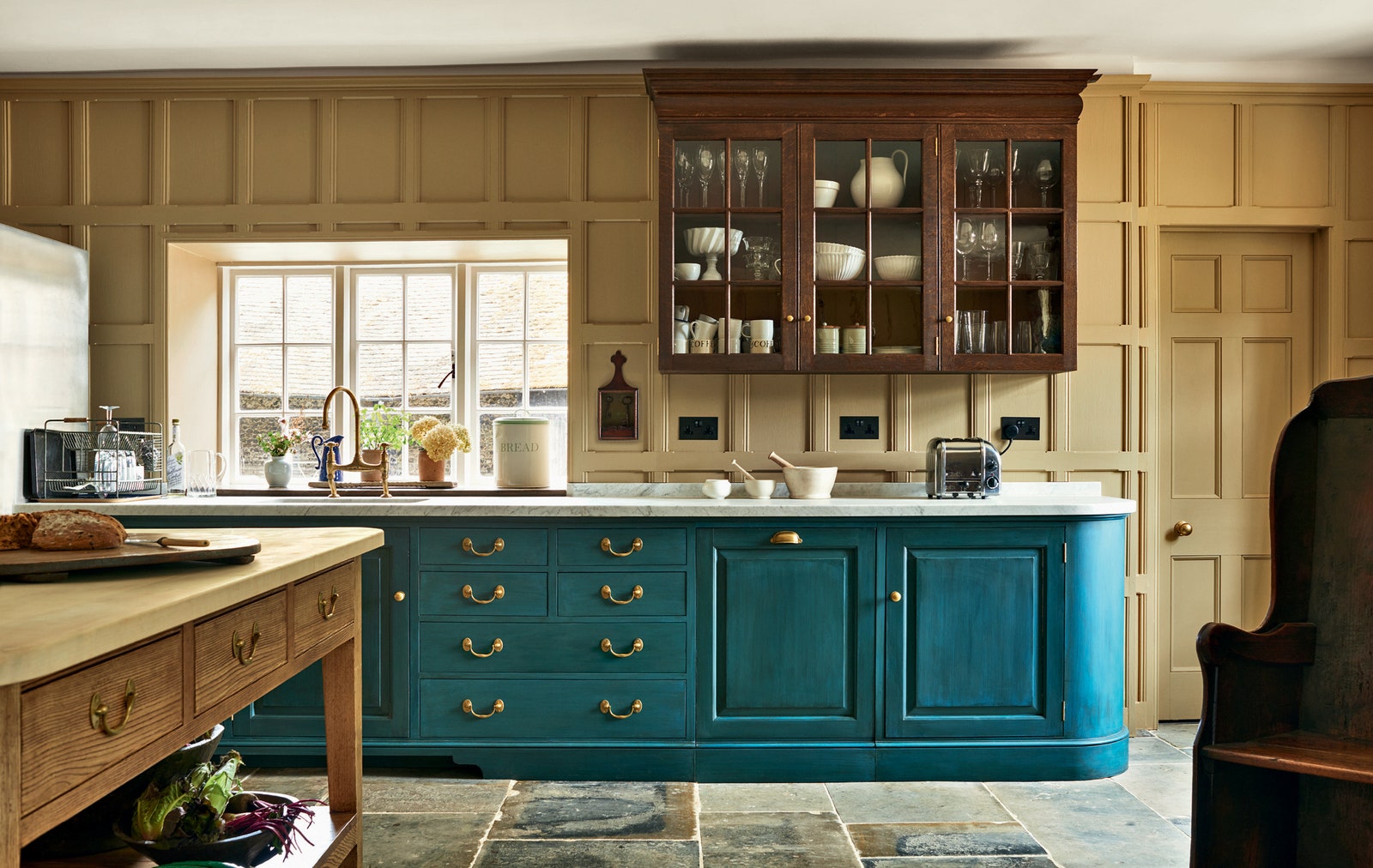
They also did a lot of thinking and research. ‘We decided not to move the kitchen – although the drawing room, which looks onto the garden at the back, was a more obvious place for it, we didn’t want to spoil the integrity of the existing layout.’ Happily, this has both charm and practicality. Constructed in 1675 as a country retreat for a retired naval captain, the building has always been a farmhouse. There was a dairy in the cellar and the kitchen is a large room at the front, on the right off the central staircase hall.
In addition to an Aga, it has an open fireplace with space round it for armchairs, and a generous work table with drawers, as well as another table that seats 10 people. Behind the kitchen, at the back of the house, are the boot room, downstairs loo and office. The other doors from the entrance hall open into the drawing room straight ahead and the dining room on the left, which in turn leads into the orangery.
MAY WE SUGGEST: Max Rollitt adds Soanean elements and a 'patina of age' to an overly modernised house
As self-confessed ‘west London minimalists’, the owners knew from the start that they would require help to furnish, decorate and restore the interior. ‘It hadn’t been spoilt, but there were cornices, chimneypieces and original floors missing. We also realised that the house needed colour, richness and antiques,’ she explains. In the end, it wasn’t difficult to find an interior designer, she says. ‘We loved Max Rollitt’s background in antiques and his historical knowledge. He was wonderfully enthusiastic about the house and also made us laugh – he has been brilliant throughout. Every decision he made turned out to be absolutely spot on.’
One such decision was the colour of the staircase hall. Max – who was recently named Interior Designer of the Year at the 2026 House & Garden Awards – explains that he wanted a shade that would complement the dark wood of the splendidly chunky 17th-century staircase and link the original part of the house with the later addition at the back, which dates from the early 1800s. ‘I hate turquoise,’ says the owner. ‘But Max insisted and, as soon as the walls were painted, I could see he was right.’
Another Max idea, initially rejected, was to turn the log store, off the boot room, into a downstairs loo. ‘The dining room had been divided to make a cloakroom and a coat cupboard. This meant we could open up and reunite that space.’ He also proposed making a drawing room window into a door onto the garden, replacing the conservatory with an orangery and creating an enfilade to give the main bedroom its own bathroom and dressing room. He found chimneypieces of the right scale and period, reclaimed flags for the kitchen, antique floorboards for the hall and drawing room and 17th-century parquet for the main bathroom, before he even started on colours, fabrics and furniture.
All are elegant, some surprising – he has a way with shades of yellow that lift a room from content to joyful – and the furniture is a mix of styles and periods, which helps to make it seem accrued over time. ‘The greatest compliment anyone can pay us is to say it looks as though we have lived here for years and done very little,’ says the owner. Which it does.
 Tom Mannion1/27
Rush Matters supplied matting for this airy room, which replaced an existing conservatory. Max designed the sofas: ‘Bridgewater’, upholstered in ‘Cunard’ by Claremont; and ‘Uppark’, in Pierre Frey’s ‘Craft’ linen. An African indigo textile covers Max’s ‘Bamboo Stool’.
 Tom Mannion2/27
 Tom Mannion3/27
 Tom Mannion4/27
Curtains made from Claremont’s ‘Faille Hamilton’ silk contrast with the dark red velvet upholstery of Max’s ‘Regency’ sofa. A painting by Paul Lemasson hangs on the left. Two armchairs are covered in ‘Musiciens Chinois’ printed cotton from Le Manach.


 Tom Mannion5/27
 Tom Mannion6/27
 Tom Mannion7/27
Max sourced reclaimed limestone flags for the kitchen floor. An antique pendant light hangs above the generous work table. The Douglas Watson Studio in Oxfordshire created the bespoke wall tiles above the Aga.
 Tom Mannion8/27


 Tom Mannion9/27
 Tom Mannion10/27
Next to a large cupboard from c1860, a door leads into a cloakroom with walls in ‘Brick’ paint by Edward Bulmer.
 Tom Mannion11/27
In the dining area, an 18th-century portrait of a Maltese knight presides over an oak refectory table. The chairs have covers by Watts of Westminster, in an 18th-century French needlepoint style.
 12/27
Walls in ‘India Yellow’ paint by Farrow & Ball create a warm atmosphere. The George III mahogany glazed bookcase, with its gothic arched doors, ebony inlay and swan-necked pediment, dates from c1770. A Regency convex mirror hangs above a dove-grey stone chimneypiece from the same period, which Max sourced from Jamb. The dining chairs are upholstered in ‘Sackville Damask’ silk from Claremont.


 Tom Mannion13/27
 Tom Mannion14/27
 Tom Mannion15/27
 Tom Mannion16/27
Bennison’s eye-catching ‘Songbird’ wallpaper is offset by curtains in a rich yellow linen by Claremont. Two gilt-framed portraits, which date from the 16th or 17th century, are displayed between the windows. An antique Persian Kirman rug complements bespoke pieces by Max, including an upholstered ‘Empire’ bed in American black walnut and a ‘Regency’ spoonback chair with ebonised decoration.


 Tom Mannion17/27
 Tom Mannion18/27
Max created an enfilade incorporating the main bedroom, the dressing room and this bathroom, where walls in Edward Bulmer’s ‘Granite Green’ paint set off an antique bath from Stiffkey Bathrooms.
 Tom Mannion19/27
 Tom Mannion20/27


 Tom Mannion21/27
 Tom Mannion22/27
 Tom Mannion23/27
 Tom Mannion24/27


